2026 Guide · AI Website Testing

The best AI website testing tools in 2026

Website QA used to mean brittle scripts and manual click-throughs after every release. AI testing tools change that: they learn your site, generate and maintain tests, catch visual regressions, and monitor critical journeys continuously. But "AI" covers a lot of ground — self-healing selectors at one end, fully autonomous agents at the other. Here's how the leading options actually differ, and which fits your situation.

How we compare them

We looked at six criteria that matter for teams choosing an AI website testing tool:

Autonomy

Does it write and maintain tests for you, or do you still author test cases?

No-code

Can non-engineers run and own testing without writing scripts or recording flows?

Visual regression

Does it detect layout and visual changes between versions?

Continuous monitoring

Does it watch your site continuously or only run on demand?

Data & compliance

Where is data processed? Is it EU-hosted? Does it train on your data?

Pricing model

Self-serve SaaS, managed service, or enterprise contract?

The tools

Profiles below are based on publicly available information. Verify current pricing and features directly with each vendor before making a purchasing decision.

Mira Checks

EU-hosted · GDPR compliant

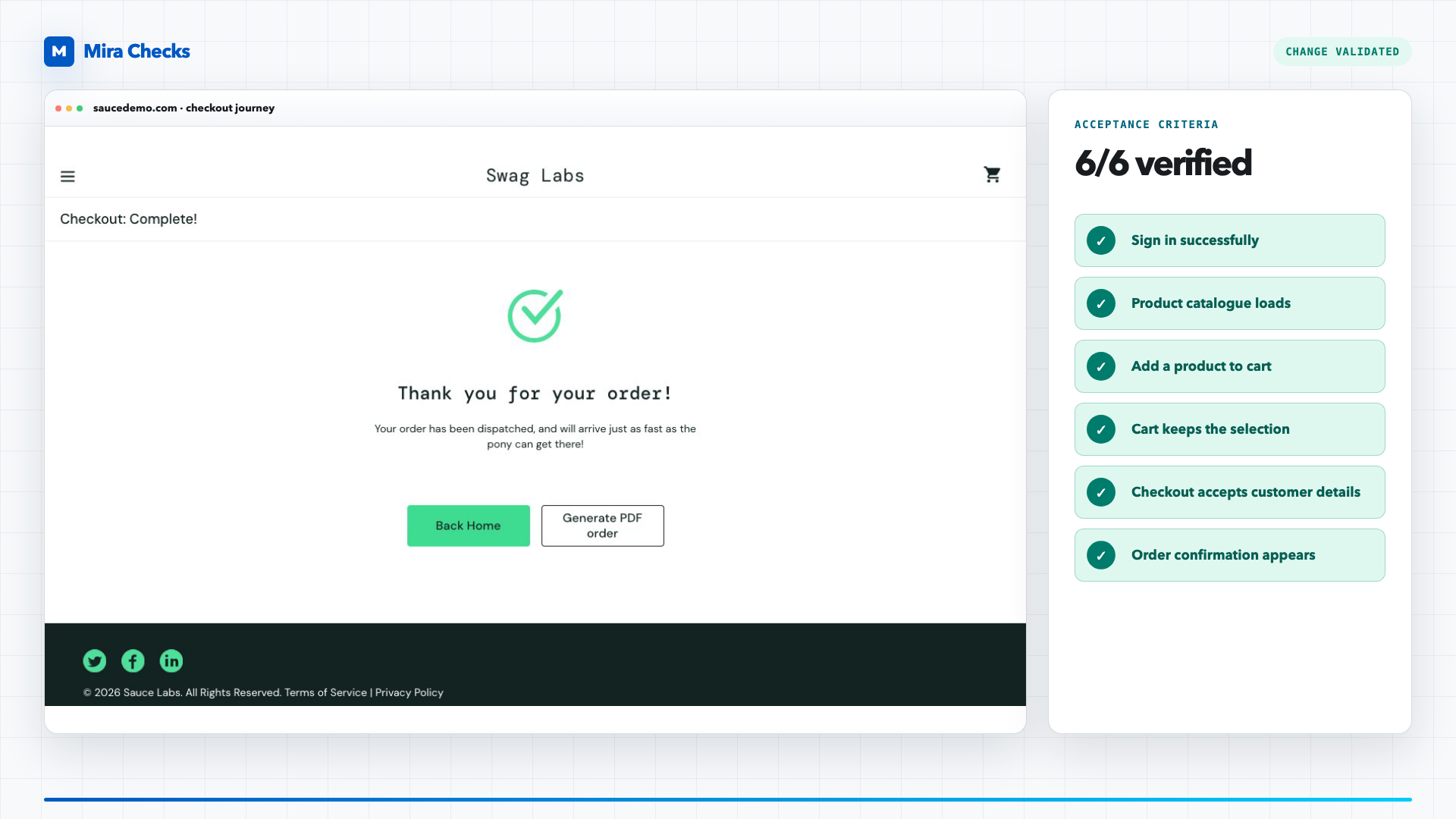
Mira is a fully autonomous AI website QA tool. It learns your site, generates tests, monitors continuously, and catches visual regressions — without any test authoring, recording, or scripting. Built for website QA (not just app testing), EU-hosted, GDPR-compliant by design, and in early access.

Fully autonomous No-code Visual regression Continuous monitoring EU-hosted No training on your data

QA Wolf

QA Wolf is a managed service that pairs human QA engineers with Playwright automation. They write and maintain your test suite on your behalf. Strong coverage and results, but it's an outsourced QA team, not a self-serve tool. See Mira vs QA Wolf →

Managed service Playwright-based Visual regression US-hosted

testRigor

testRigor lets teams write functional tests in plain English rather than code. You still author test cases — but in natural language instead of Playwright or Selenium. Good fit for teams that want explicit test coverage without scripting. See Mira vs testRigor →

Natural-language tests Web & mobile US-hosted

Mabl

Mabl is a mature low-code testing platform with AI-powered self-healing. Teams record journeys and Mabl keeps them passing as the UI changes. Extensive CI/CD integrations and a large feature set — best for QA teams that want detailed control. See Mira vs Mabl →

Low-code Record-and-replay AI self-healing CI/CD integrations US-hosted

Reflect / Ghost Inspector

Record-and-replay tools that make testing accessible without code. You record browser interactions and they run as automated tests. Good for small teams getting started — but recordings break with UI changes and coverage is limited to what you remember to record. See Mira vs Reflect →

No-code Record-and-replay US-hosted

Applitools

Applitools specialises in visual AI testing — comparing screenshots across browsers, devices, and viewport sizes with high accuracy. It augments existing Selenium or Cypress suites rather than replacing them. Best for teams that already have a test framework and want to add visual regression coverage.

Visual AI Augments existing tests Cross-browser US-hosted

BrowserStack

BrowserStack provides cloud infrastructure for running tests across real browsers and devices. It's a test execution platform, not a test authoring tool — you bring your own Selenium/Playwright/Cypress tests and BrowserStack runs them at scale. Essential for cross-browser coverage.

Cross-browser grid Real devices Requires existing tests US-hosted

How to choose

The right tool depends on your team's situation:

You want zero test authoring

→ Mira Checks. Fully autonomous — no scripts, no recordings, no natural-language test steps.

You need EU data residency / GDPR

→ Mira Checks. Most tools in this category are US-hosted SaaS. See GDPR-compliant website testing.

You want to outsource QA entirely

→ QA Wolf. They assign human engineers to write and maintain your test suite.

You need a mature platform with CI/CD depth

→ Mabl. Established platform, extensive integrations, detailed reporting.

You already have Selenium/Playwright tests

→ BrowserStack (execution) + Applitools (visual regression). Augment what you already have.

You're just getting started, low budget

→ Reflect or Ghost Inspector. Record-and-replay is the fastest entry point — upgrade when recordings become a maintenance burden.

Where Mira fits

The teams Mira is built for share one thing: they don't want to manage a test suite. Point it at a URL and it maps the site, builds coverage, and monitors continuously. EU hosting and GDPR-compliant infrastructure are defaults. Nothing to configure on the compliance side.

If data residency and a hands-off setup matter more than a large scripting ecosystem, Mira is the strongest fit. It's in early access — sign up below to be first in line.

Also read: How to test your website after every deployment · GDPR-compliant website testing

Frequently asked questions

What is the difference between AI testing and traditional test automation?
Traditional test automation requires engineers to write and maintain scripts. AI testing tools can learn your site, generate test cases, self-heal when the UI changes, and in some cases run entirely autonomously without manual test authoring.
Are AI website testing tools no-code?
Some are, some aren't. Reflect and Ghost Inspector use record-and-replay (no code, but manual recording). testRigor uses plain-English test steps. Mira Checks is fully autonomous — no scripts, no recording, no test authoring of any kind.
Which AI website testing tool is best for EU/GDPR requirements?
Most tools in this category are US-hosted SaaS products. Mira Checks is purpose-built for European requirements: EU-hosted infrastructure, GDPR-compliant by design, no training on customer data, and AI processing through a single EU provider (Mistral AI, France) under a Data Processing Agreement. See our GDPR-compliant website testing page for details.

Try the autonomous, EU-hosted option — get early access to Mira

Mira is in early access. Sign up to be first in line when we open up.